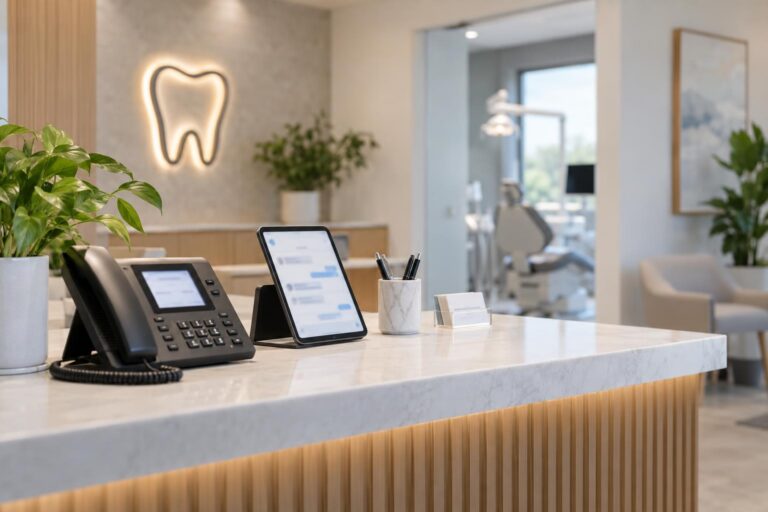
Where Dental New-Patient Calls Leak: Fixing the Front-Desk Gap Behind Marketing ROI
Marketing brings calls, but are they booking? Here is where dental new-patient calls leak at the front desk and how to measure and fix it.

Why can a dental campaign produce calls without producing the appointments the practice expected? The gap may involve availability, routing, insurance questions, or an unclear next step. The first useful response is to inspect the call journey before buying more demand or blaming the front desk.
We recommend a small operational review built around eligible appointment opportunities. Count what happened, identify the obstacle, and assign a fix. A ringing phone is an event; a suitable patient attending an appropriate appointment is a different outcome.
Follow one call from the invitation to the schedule
Read the page or advertisement that prompted the call. What did it imply about the service, location, timing, and next step? Then compare that invitation with what the receiving team can actually arrange.
A caller may be responding to a specific promise that staff never saw. If the campaign emphasizes immediate access while the schedule offers only later dates, the team starts the conversation by correcting expectations.
Check the number and routing at the times the campaign is active. Confirm what happens during office hours, lunch coverage, planned closures, and after hours. A forwarding arrangement should be tested through the practice’s approved process rather than assumed to work.
Map the handoff when the first person cannot resolve the question. Does the caller receive a clear next step? Does someone own the callback? Where is the task recorded?
Separate missed calls from unsuitable inquiries
Use categories that help the practice act. An unanswered call, a wrong number, a current patient’s administrative question, and a new-patient request are not the same kind of opportunity.
Within suitable new-patient inquiries, distinguish booked, declined, pending follow-up, and unavailable appointment type. Keep the definitions brief enough that staff can apply them consistently.
Do not infer motivation from silence. A person who did not book may have encountered a scheduling conflict, needed coverage information, or chosen another route. Record what is known and leave the rest unknown.
Deduplicate repeated contact where the approved system allows it. Several calls about one appointment should not become several new-patient opportunities in the report.
Use a weekly call-review worksheet
| Field | What to capture | How it helps |
|---|---|---|
| Source | Known campaign or referral route, with unknown allowed | Avoids invented attribution |
| Time context | Staffed hours, after hours, or closure | Identifies coverage mismatches |
| Call category | New-patient request, existing patient, duplicate, or other | Keeps the denominator meaningful |
| Administrative obstacle | Availability, routing, coverage question, or unclear service | Directs a practical repair |
| Next step | Booked, callback assigned, secure referral, or declined | Makes the handoff visible |
| Owner | Person responsible for unresolved follow-up | Prevents an unowned queue |
Keep clinical details and identifiable information in the practice’s approved systems. The marketing review needs a broad operational pattern, not a transcript of someone’s health history.
Review a manageable period and discuss exceptions with the people who handled them. A worksheet cannot fully explain the conversation, and a single difficult call should not become a judgment about an employee’s ability.
Do not start with recording as the default
Before recording or transcribing calls, obtain the practice’s legal and privacy review of the intended workflow, including the locations of the participants and any vendors. Do not assume one consent rule applies to every call.
An operational review can begin with approved disposition records and staff observations. If recordings are authorized, define access, purpose, retention, and review responsibility before collecting them.
Do not upload patient conversations into a general AI service merely because it offers summarization. The practice should approve the tool and data handling for the actual use.
The healthcare tracking guidance also requires careful attention to actual data flows and includes a notice about a partially vacated public-page theory. Avoid blanket claims that every website visit is protected health information, while still examining what the practice actually discloses.
Give staff a useful way to answer insurance questions
Distinguish the practice’s participation information from a promise that a particular service is covered for a particular person. Staff should know which facts they may state and how to route questions that require plan-specific confirmation.
A practical response explains the next step without promising a financial outcome. For example, the team can offer to discuss the practice’s process for checking information and preparing an estimate, using its approved wording.
Do not train staff to overcome every hesitation as if it were a sales objection. A person may need time to understand cost or coverage. Accurate information and a clear route are more appropriate than pressure.
Review whether the website creates the same distinction. If it says “we take your insurance” broadly, callers may arrive with expectations the front desk must undo.
Offer the appointment that actually exists
Have the scheduling lead identify what staff can offer for each inquiry category. Separate an assessment from treatment, hygiene from doctor time, and one office’s availability from another’s.
If the preferred slot is unavailable, staff should know the approved alternatives and how to discuss them. Avoid implying that a waitlist or callback guarantees a particular date.
For multi-location practices, confirm whether a transfer is appropriate and convenient for the caller. Do not move the request to another location without making the change clear.
A hypothetical example illustrates the issue: a campaign invites new patients to an evening appointment, but only morning assessment slots remain. The first fix may be the invitation or schedule information. Coaching the receptionist to sound more enthusiastic does not create an evening slot.
Make the local arrival information part of the handoff
Ask each office to verify its address, entrance, parking instructions, and the appropriate route for accommodation questions. Give staff access to the same information published on the website.
Check whether the booking confirmation identifies the correct location. A group practice can have a working central number and still send someone to the wrong office if the location is unclear in the handoff.
Use the front desk’s real observations to improve the page. If visitors repeatedly ask which entrance to use, a verified instruction or authentic photograph may be more useful than another paragraph about the neighborhood.
Do not claim multilingual service, extended hours, or a specific accessibility feature without confirmation. Local detail should reduce uncertainty, not decorate the copy.
Connect call measures to business outcomes carefully
A phone-related key event can record an important digital action, but it does not establish that a conversation occurred or an appointment was attended. Keep clicks, completed calls, bookings, and attendance separate.
When evaluating marketing ROI, have the financial owner define the relevant costs and outcomes. Do not multiply raw calls by an assumed patient value and present the result as collected revenue.
Compare similar periods and annotate office closures, staffing changes, and campaign changes. A decline in booked appointments during reduced availability needs that context before anyone judges the advertising.
Use the review to identify the next fix: a routing correction, clearer appointment language, better task ownership, or a capacity decision. Then check whether the identified problem has been resolved.
Coach the process without shaming the team
Bring a specific example to the discussion and ask what information or authority would have helped. Staff may be trying to manage a queue while working with an unclear offer or a restrictive schedule.
Choose one change the practice can support, such as an approved insurance explanation or a callback ownership rule. Document it, explain it, and review its use. Avoid turning the review into a competition over who books the most callers.
If the team identifies an upstream problem, assign it to the appropriate owner. The front desk should not carry responsibility for a campaign claim it did not approve or a booking tool it cannot repair.
Inspect the handoff between a missed call and a callback
A missed call creates a task only if someone can identify the appropriate next step under the practice’s procedures. Check where that task appears, who reviews it, and how completion is recorded. Do not assume that a notification alone establishes ownership.
Have the practice approve callback and voicemail wording. Staff should know how to respond when a different person answers and how to respect a communication preference. The goal is a suitable follow-up, not repeated attempts until the record can be marked booked.
Review the queue at a practical interval determined by staffing. Distinguish a task waiting for an internal answer from a person who has not responded. Those situations need different actions.
If callbacks repeatedly reach people at unsuitable times, ask whether the practice can offer an approved way to state a preferred contact window. Do not promise that preference will always be met if the team cannot support it.
Use one corrected conversation as a training exercise
Choose a hypothetical scenario based on an operational issue, without reproducing private patient details. For example, a caller asks about a service at an office where it is not offered. Ask the team to explain the available route clearly and check whether the website invitation needs correction.
Have staff identify the information they lacked. Was the service directory unclear? Did the campaign use a different name for the appointment? Was the receiving number connected to the wrong office? The answer may be a system repair rather than a new script.
Write the approved process in the place staff already use for operational guidance. A training document stored only in an agency folder will not help someone handling a busy phone line.
At the next review, inspect whether the same obstacle remains. If it does, investigate whether the repair was implemented and understood before deciding the staff need more coaching. This keeps the review focused on the whole journey and gives the team a fair opportunity to improve it.
Ask staff to distinguish an unavailable appointment from a failed conversation. That difference matters when deciding whether the next investment belongs in marketing, staffing, or scheduling capacity. Record the distinction consistently so the review does not reward pressure or penalize an accurate answer.
What people get wrong
Is every missed call a lost new patient?
No. Classify the contact where possible and keep uncertainty visible. Raw call counts do not establish the number of suitable opportunities.
Will a better script fix a full schedule?
No. A script can explain options accurately, but capacity needs an operational decision.
Can AI score staff from call transcripts alone?
Do not treat an automated score as a complete account of the interaction. Review context, authorized data use, and the system constraints staff faced.
Will improving the call process guarantee ROI?
No. It can address identifiable obstacles and improve the evidence available for decisions. Financial results still require appropriate measurement and cannot be promised.
Where does your practice’s call journey need attention?
Discuss the next step with Geeks for Growth for your U.S. practice or agency.
Explore Dental Marketing Services · Request Strategic Guidance · Browse Resources
Related Posts