The Rise of AI-Driven Workflows in Design Services: How Startups and SMBs Are Scaling Creative Assets in 2026
Discover AI-driven design workflows in 2026. Learn how startups and SMBs use AI graphic design tools and creative automation to scale creative assets fast.

A design trend creates business value only when it improves recognition, comprehension, accessibility, or conversion for a defined audience.
Our team sees the same failure pattern repeatedly: channels are added before the offer, message, and feedback loop are clear. This guide focuses on the sequence and decisions that make the tactic useful. See Design Services for Startups & SMBs for the service context and Geeks for Growth for the broader system.
The Evolution of Creative Scaling: From Generation to Intelligent Action
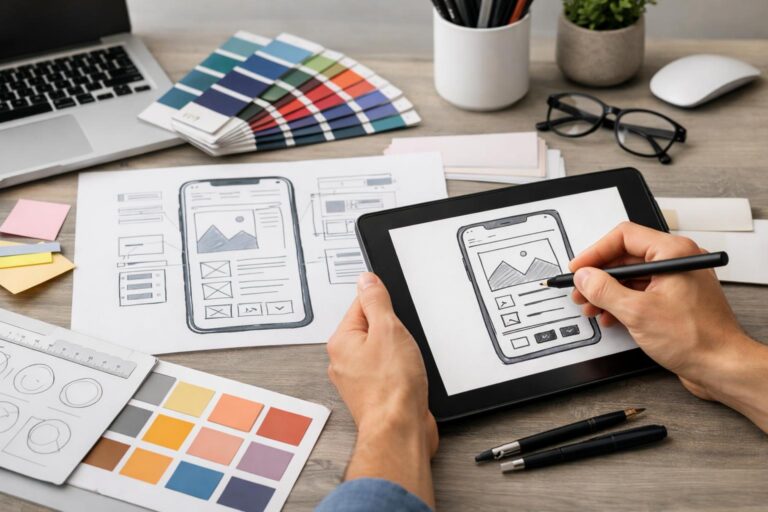
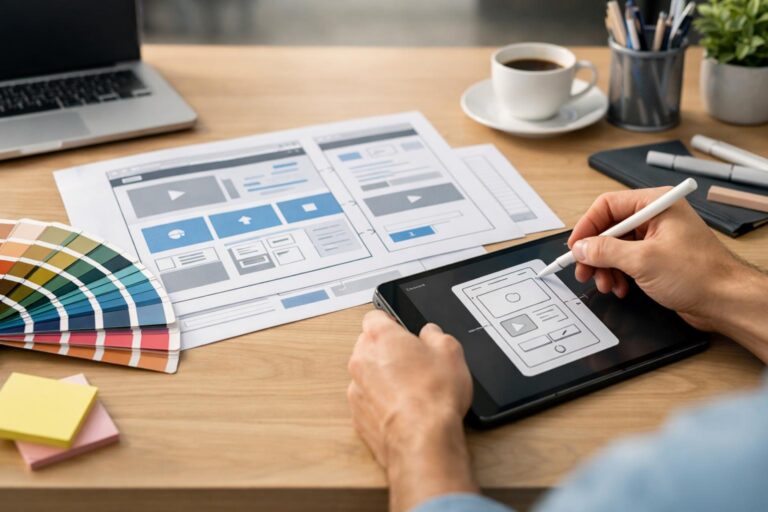
For several years, artificial intelligence in the creative sector was treated as a novelty tool primarily used for swift brainstorming or rough asset conceptualization. However, in 2026, the paradigm has shifted from basic prompt-to-image outputs to sophisticated, autonomous agents integrated directly into daily design systems. Modern AI graphic design tools no longer just generate isolated files; they read complex codebase repositories, understand strict style sheets, and execute cross-platform variations with minimal human intervention.
This evolution enables true SMB creative automation. Rather than spending valuable hours resizing banners, manually adjusting color palettes for dark mode, or configuring layout grids for localized web pages, designers are stepping into strategic editorial roles. They define parameters, deploy design agents to execute multi-screen layouts, and establish critical human checkpoints to help support final visual quality remains hyper-refined. This approach—often referred to as “hybrid craft”—deliberately blends automated scalability with human nuance, culture, and emotional precision.
Key Tooling Categories Redefining the Modern Design Stack
Achieving structural scaling requires understanding where different AI platforms fit within an organization’s creative pipeline. The ecosystem in 2026 relies on specialized, integrated platforms designed to solve specific workflow inefficiencies:
| Tool Category | Primary Business Benefit | Core Operational Function |
|---|---|---|
| Canvas-Integrated AI | Frictional reduction for existing teams | Autonomously builds matching layout variations directly inside shared company canvases, preserving historical asset systems. |
| Prompt-to-Live Systems | Hyper-accelerated web deployment | Translates descriptive plain language directly into fully functional, responsive landing page blocks ready for client testing within hours. |
| Full-Stack Full-Fidelity Builders | Bridging the designer-developer divide | Generates clean, production-ready frontend code structures from raw layout templates, cutting dev-handoff timelines by up to half. |
| Enterprise Asset Engines | Commercially safe scale | Utilizes safe, legally compliant models trained exclusively on licensed content to allow rapid scaling without legal risk. |
Why On-Demand Infrastructure Beats Traditional Expansion
When a startup experiences rapid user acquisition or market expansion, the immediate instinct is often to hire additional full-time production personnel. However, in modern business environments, scaling revenue exponentially without a proportional surge in operational overhead is a practical goal. Traditional hiring trends solve volume problems by compounding internal management complexities, often leading to designer burnout and fragmented execution.
Utilizing specialized, on-demand design services embedded with AI automation provides an elastic solution. For instance, niche markets like legal technology are experiencing unique transformations. Tracking the latest legal tech design trends 2026 reveals that professional service providers are heavily leveraging automated design workflows to synthesize technical information into highly accessible, compliant, and engaging consumer graphics instantly. This model allows businesses to pay for precise operational results rather than hours spent on repetitive manual iteration.
Strategic Roadmaps for Implementation
Successfully transitioning away from legacy design practices requires a structured, deliberate approach to prevent team disruption and help support absolute brand consistency:
- Audit Current Vulnerabilities: Track exactly where your internal teams spend their creative hours. Identify repetitive localization and resizing tasks that are prime targets for immediate automation.
- Deploy Single-Point Integrations: Avoid overwhelming your workflow by testing five systems simultaneously. Master a singular AI design tool within one specific project phase before scaling adoption outwards.
- Run Isolated Parallel Sprints: Evaluate real operational efficiency by running a traditional creative sprint side-by-side with an AI-assisted pipeline on an active, low-risk project to contrast clear turnaround data.
- Establish Strict Human Verification: Build explicit editorial and brand-compliance checkpoints into the system so that no fully automated asset transitions to external deployment channels without human verification.
Use these primary or authoritative references to verify current guidance: Google Search Central: AI features and your website; Google Search Central: helpful, reliable, people-first content. Where this article discusses trends, treat them as planning context rather than guaranteed outcomes.
Want to identify the constraint before adding another tactic?
Review Design Services for Startups & SMBs, then bring the current offer, audience, funnel, and measurement. We will help you locate the gap and define a useful next test.
Related Posts