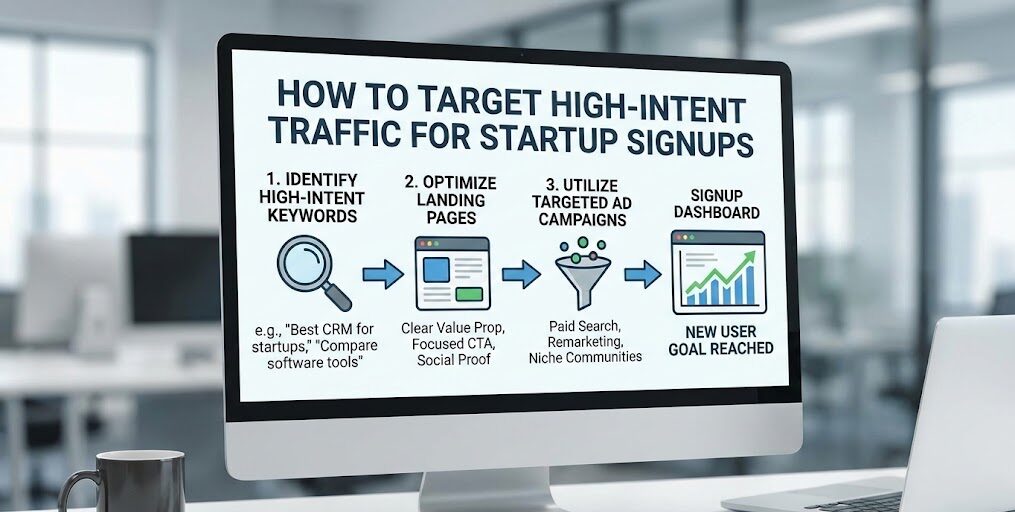
How to Target High-Intent Traffic for Startup Signups
Traffic is up, but signups are flat? The issue is rarely volume. It is intent. If your acquisition is attracting the wrong audience, even strong product-market fit will struggle to convert.
This guide shows how to use High Intent SEO for Startups, Startup Conversion Rate Optimization, and an intent based content strategy to close the gap between visibility and conversion.
Start here if this is your situation: Why Does My Startup Get Traffic but No Signups?
How to Target High-Intent Traffic for Startup Signups
Many early-stage founders face the same frustrating problem: traffic is growing, but signups are flat. The issue is rarely volume. It is intent. If your acquisition strategy is attracting the wrong audience, even strong product-market fit will struggle to convert. High Intent SEO for Startups is not about ranking for more keywords. It is about aligning search intent, messaging clarity, and funnel structure to attract people who are already motivated to take action.
If you are experiencing strong sessions but weak activation metrics, it is worth reviewing the underlying acquisition strategy. We explore this challenge in detail in Why Does My Startup Get Traffic but No Signups?, where we break down the structural gaps between visibility and conversion.
What Has Shifted in the Past 30 Days
Recent algorithm updates and SERP layout changes have reinforced a clear pattern: search engines are prioritizing intent alignment over keyword density. AI summaries, featured snippets, and comparison modules increasingly reward content that directly solves high-friction problems rather than broad educational content.
For startups, this means two things:
- Broad awareness traffic is less reliable for conversion. Informational queries are increasingly answered directly in search results.
- Decision-stage content is gaining more strategic value. Pages that address pricing, use cases, integrations, comparisons, and onboarding clarity are converting more consistently.
High intent SEO for startups now requires mapping content directly to the early stage conversion funnel instead of publishing top-of-funnel volume content and hoping users self-qualify.
Understanding High-Intent Traffic
High-intent traffic refers to users who are actively evaluating solutions, not just researching a category. These users search differently. They use comparison phrases, problem-specific language, and solution-oriented modifiers.
Low Intent Examples
- What is product analytics
- How startups grow users
- Best SaaS tools
High Intent Examples
- Best onboarding tool for B2B SaaS
- Reduce churn for early stage startup
- Improve activation rate SaaS dashboard
- Tool to increase free trial conversions
Targeting qualified traffic requires identifying these behavioral patterns and building pages specifically designed to meet that intent.
Aligning Content to the Early Stage Conversion Funnel
Instead of organizing content purely by topic, high-performing startups organize by funnel friction.
| Funnel Stage | User Question | Content Focus |
|---|---|---|
| Problem Aware | Why are my users not converting? | Diagnostic guides and benchmarks |
| Solution Aware | How do I fix low signup rates? | Strategic frameworks and use cases |
| Decision Stage | Is this tool right for me? | Comparisons, onboarding clarity, ROI breakdown |
Most startups over-invest in the first row and under-invest in the third. Startup Conversion Rate Optimization begins at the decision layer, not the awareness layer.
Why this matters: You can only get more signups if you understand where the funnel leaks. This breakdown of the four funnel phases helps you diagnose whether your problem is traffic quality, message clarity, activation friction, or follow-up.
Fixing the Traffic-to-Signup Gap
If you are trying to fix website traffic no conversions, focus on these structural improvements:
1. Intent-Based Content Strategy
Create pages that match transactional language. Build landing pages around use cases, integrations, pricing scenarios, and real customer outcomes. Avoid vague positioning.
For example, instead of writing about growth marketing trends, write about how to improve onboarding completion rates for Series A SaaS companies.
2. Tight Message-to-Market Alignment
High intent users scan quickly. They look for confirmation that your product solves their exact problem. Clarify:
- Who the product is for
- Who it is not for
- What problem it solves specifically
- What measurable outcome it drives
This is where many startups lose qualified traffic. The visitor may be ready to convert, but the messaging does not validate their context.
Operator rule: If the visitor can’t explain what you do, who it’s for, and what happens after they sign up within 10 seconds, you have a clarity problem—not a traffic problem.
3. Remove Activation Friction
Increasing startup signups requires simplifying the first step. Reduce required fields. Clarify next actions. Show onboarding previews. Highlight social proof relevant to your ICP.
Conversion optimization is not about button color. It is about cognitive clarity.
Strategic Shifts Startups Should Consider
Several tactical adjustments are proving effective:
- Comparison Content: Build pages comparing your solution to alternatives.
- Use-Case Landing Pages: Segment by industry or workflow.
- Intent-Based Internal Linking: Guide users from problem guides to signup-focused pages.
- Activation-Focused CTAs: Replace generic free trial language with outcome-based framing.
If you want a deeper breakdown of structural growth systems, review our broader approach to startup marketing strategy at Startup Growth and Company Marketing. The emphasis is always on compounding systems, not short-term acquisition spikes.
Practical add-on: If Instagram is part of your acquisition mix, a simple funnel matters more than “more posting.” Use this as a quick reference for building a clear path from view to click to signup.
Measuring What Actually Matters
Targeting qualified traffic changes how you evaluate success. Instead of tracking sessions, prioritize:
- Signup rate by traffic source
- Activation completion percentage
- Time to first value
- Cost per activated user
High intent SEO for startups should lower acquisition waste and increase activation efficiency. If those metrics do not improve, the traffic is still misaligned.
Final Thoughts
Startups do not need more traffic. They need better-aligned traffic. By structuring an intent based content strategy around decision-stage queries, tightening message clarity, and removing early stage conversion funnel friction, founders can convert existing demand more effectively.
If your startup is generating traffic but struggling with signups, the issue is likely structural rather than promotional. At Geeks For Growth, we help early-stage teams design acquisition systems that attract qualified traffic and convert it predictably. Explore our resources, or reach out for strategic guidance to turn visibility into measurable signup growth.
Want to Turn Traffic Into Signups?
If your analytics show traffic up, conversions flat, you likely have an intent mismatch, a clarity gap, or activation friction.
We help startups build search-driven content systems, conversion-focused pages, and measurement loops that improve signup quality—not just volume.
Explore Startup Marketing Talk to Geeks for Growth Read the Traffic-to-Signup Guide